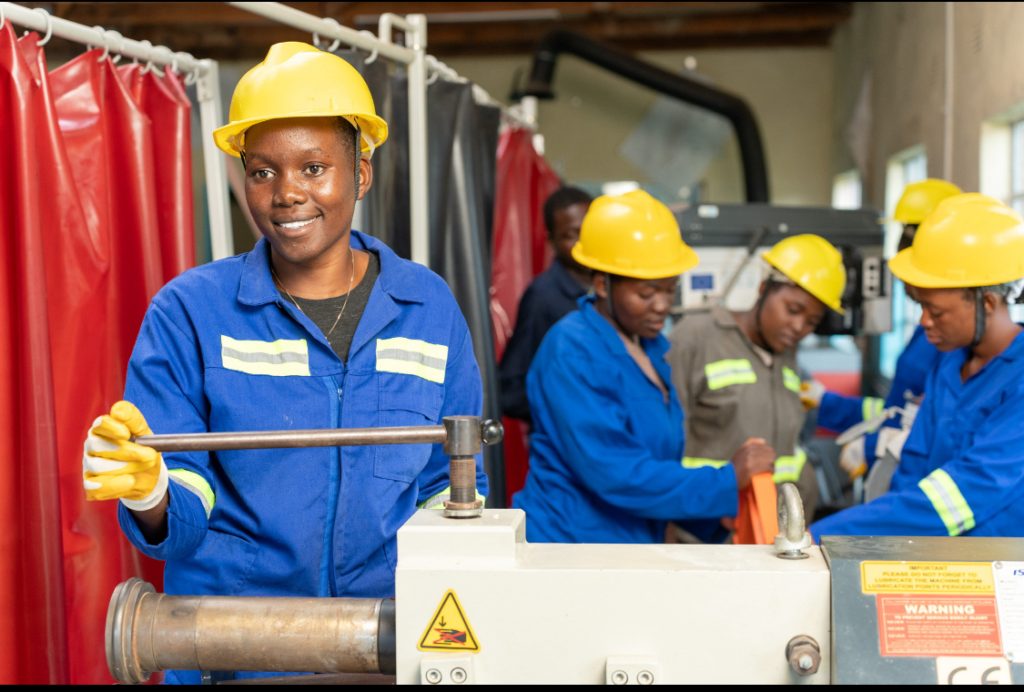
Located in Group Village Head Mackenzie in Traditional Authority Matola approximately 10 kilometres north of Balaka Town, Khwisa Community Technical College has excelled since it opened its doors in 2019, offering skills training to youth eager to transform their lives.
One such youth is Stanton Asiki, 33, who plies his trade in Malawi’s capital city, Lilongwe, and is delighted with the progress he has made over the years.
He has a steady income, owns the necessary equipment for his trade, and supports his wife who is currently pursuing a course in tailoring, fashion and design, among his achievements.
Despite having a Malawi School Certificate of Education, finding employment was challenging for the youthful Asiki. Starting a business venture was not an option either due to a lack of capital.
However, when Asiki decided to enroll in a solar photovoltaic installation course at Khwisa Community Technical College in 2021, he did not realise how much it would positively impact his life.
“Now I am a qualified solar photovoltaic installation technician. In a good month I can earn K500 000 or more which is enough for me to earn a decent living”, Asiki, who hails from Chipwere Village in Traditional Authority (T/A) Msamala in Balaka District, says.
“I have bought my own tools and I am also supporting my wife’s education in tailoring, fashion and design at Miracle Technical College in Karonga.”
The population of Malawi is predominantly youthful, with 51 percent under 18 years of age, according to the 2018 Malawi Population and Housing Census.
Despite their significant proportion, young people have not realized their full potential due to age-related challenges and barriers such as lack of experience, relevant education and skillsets.
The International Labour Organisation (ILO) emphasises the importance of investing in technical and vocational education and training (Tvet) to equip young people with practical skills needed to thrive in an evolving labour market and improve their overall quality of life.
With only eight public national technical colleges offering formal Technical, Entrepreneurial and Vocational Education and Training (Tevet) in Malawi, there is a significant gap in meeting the demand for quality Tevet.
For instance, National Pre-Apprentice Recruitment records in 2013 indicate that 11 215 candidates applied to go to these technical colleges but only 1 084 were selected.
To address this gap, the government under the then leadership of President Arthur Peter Mutharika (2014-2019), prioritised the establishment of Community Technical Colleges (CTCs) in all districts and constituencies as a strategy to ensure equal access to quality Tevet in Malawi.
A CTC provides educational facilities to youth and other members of the community.
Malawi 2063 recognises skills development as a critical component of human capital development essential for achieving pillars of Agricultural Productivity and Commercialisation, Industrialisation, and Urbanisation.
Ministry of Labour and Innovation director of technical and vocational training Richard Chirwa reports that there are 22 operational CTCs evenly distributed across the country, with another six under construction.
Since its inception, Khwisa CTC continues to equip youths with technical skills in various trades. According to Khwisa CTC principal, Mabvuto Mtitimila, since the college opened for formal programmes, 641 students have progressed to Level 3 either under government sponsorship or self-sponsorship (parallel) programme.
He says the college currently offers nine Tevet Authority approved courses, including bricklaying, carpentry and joinery, fabrication and welding, plumbing, tailoring, fashion and design (TFD), solar photovoltaic installation (Renewable Energy) and information communication and technology (ICT). Additionally, Automobile mechanics and electrical installation and electronics are offered under a parallel programme.
According to the authority’s spokesperson Carol Magreta, the delivery of quality Tevet has always been a priority for the Tevet Authority.
“All Tevet institutions are expected to align their programmes with set standards to ensure uniformity, relevance and industry responsiveness. This is achieved through accreditation, registration and continuous monitoring of institutions and programmes to ensure compliance,” says Magreta.
Khwisa CTC is one of the nine community technical colleges offering a solar photovoltaic installation course, equipped with modern equipment donated by the European Union.
Additionally, an informal solar photovoltaic installation training funded by the Danish Trade Union in collaboration with Malawi Congress of Trade Union and Employers Consultative Association of Malawi is underway.
“So far 124 students have been trained under this project. The target is to train 168 youths. Students under this project are fully sponsored”, says Mtitimila.
Village Head Ositeni under T/A Matola who has seen the positive impact of the college on his village, expresses gratitude to the government for establishing the CTCs programme.
“I have a good number of youths in my village who have graduated from the college and are now either self-employed or working elsewhere. It is heartwarming to see youths, especially young girls, who graduated from this college being called to construct houses and some being called to install solar panels,” quips the village Head.
Gloria Tewesa, 22, from Nsanama Village under T/A Kawinga, can see a brighter future after she completes her course and thinks she made the right decision to go for technical education.
“Since I started my training in January this year our instructors have been trying their best to ensure that we master the skills,” says Tewesa who intends to start a tailoring shop after completing the training.
However, Tewesa, currently pursuing a TFD course, laments about inadequate training materials, which she says are affecting delivery of quality training.
She explains: “In some trades like tailoring, fashion and design, we have 30 sewing machines but only 20 are working yet we have 28 students in this class. Sometimes we have to source our own sewing machine parts like bobbins.”
Village Head Ositeni agrees with Tewesa, adding that the college also lacks infrastructure like staff houses, hostels and a recreation hall for students.
“We receive students from as far as Liwonde National Park and even some from Chikwawa. We need hostels for these students, especially girls.
“There is also a need for a borehole at the college because tap water is not reliable. Sometimes these students have to walk long distances to fetch water when the taps run dry,” says Ositeni.
The college principal acknowledges the existence of these challenges.
“For instance, in tailoring fashion and design, students use ordinary manual sewing machines instead of industrial sewing machines to prepare them for the industry,” Mtitimila says.
The principal says students are encouraged to buy their sewing machine parts to ensure that they take care of them as a measure to minimize theft and misuse of the machine parts.
Mtitimila explains that as a way of assisting those students with accommodation challenges and income generation, the college renovated two old classroom blocks to accommodate the students.
On his part, Chirwa acknowledges that his ministry is aware of the funding inadequacies in CTCs which he says have arisen due to an increase in the cost of training materials, tools and equipment.
“The main sources of funding have been the government’s Other Recurrent Transactions (ORT) funding, training subsidies from the Tevet Authority and in some cases, development funding from partners. The government is also exploring industry participation in financing training and collaborating with stakeholders to review the funding modalities,” says Chirwa.
Ironically, the previous administration ‘abandoned’ the CTCs program and introduced its version – The National Youth Service (NYS) Programme. This was launched by former president, Lazarus Chakwera at Chikonde Primary School in Neno on July 19 2022 with a promise “to build a nation of youths who are productive and contribute to the country’s productivity”.
For five years, the CTCs programme appeared to be operating on a ‘mute button’ as the NYP enjoyed the prevailing political will at that time.
The good news is that the current administration looks poised to breathe a new lease of life into these CTCs programme. During his State-of-the-Nation Address on February 13 2026 Mutharika pledged to revitalise the CTCs, resume constructing those that were abandoned and allocate K100 million soft loans for the youth in every constituency, every year starting in the 2026/27 Financial year.
This would ensure that more youths like Asifi acquire valuable skills to lead independent and prosperous lives after graduation.
“Given the rising youth unemployment, the community technical colleges programme remains the most sustainable way of creating job opportunities for the youth,” Asiki says.